You have seen a MicroLED wall in a showroom, a luxury home, or a theater, and now you want the number. You search online and find vague ranges, “contact us” pages, and plenty of beautiful pictures. Very few companies explain what a MicroLED video wall actually costs.
So let’s fix that. MicroLED video wall cost for a residential project in 2026 typically runs from about $20,000 to well over $100,000, depending on size, pixel pitch, resolution, processing, installation, architecture, and integration. For many premium homes, a realistic planning range is 25,000–60,000 for a 130–165-inch system. Highly customized, ultra-fine-pitch 4K–8K installations can reach 70,000–150,000+.
The important part is knowing what you are paying for. A MicroLED wall is not a pile of LED panels. The final system includes the display, video processing, mounting structure, electrical work, installation, calibration, control integration, shipping, and service. This guide breaks down the real numbers for our residential MicroLED displays. If you are new to the category, start with our complete guide to LED walls.
Quick Answer
A residential MicroLED video wall costs roughly 20,000–60,000 for most 120–165-inch systems, and 75,000–150,000+ for large, ultra-fine-pitch custom installations. Price depends on size, pixel pitch, resolution, processing, installation, and integration. Compare complete installed quotes, not panel prices.
Let’s start with the number most homeowners want. These are planning ranges for a professionally designed and installed premium residential system.
| Wall size | Typical residential budget | Premium / custom budget |
| 100–120″ | 15,000–25,000 | 25,000–40,000+ |
| 130–140″ | 20,000–35,000 | 35,000–50,000+ |
| 150–165″ | 30,000–60,000 | 50,000–80,000+ |
| 180–205″ | 45,000–80,000 | 70,000–120,000+ |
| 200″+ custom | $60,000+ | 100,000–150,000+ |
Planning ranges, not universal retail prices. Actual pricing moves with pixel pitch, screen geometry, processor, mounting, electrical requirements, room construction, and integration.
Current 2026 LED market references show installed pricing of roughly 1,500–2,500 per square foot for fine P1.5–P1.9 systems, and approximately 2,500–4,000+ per square foot for premium sub-P1.2 systems. Residential projects can price higher per square foot than large commercial installs, because engineering, processing, shipping, and installation are fixed costs spread over fewer square feet.
So when someone says, “A MicroLED wall costs $500 per square foot,” ask one question: does that include installation, structure, processing, calibration, power, and commissioning? Often, it does not.
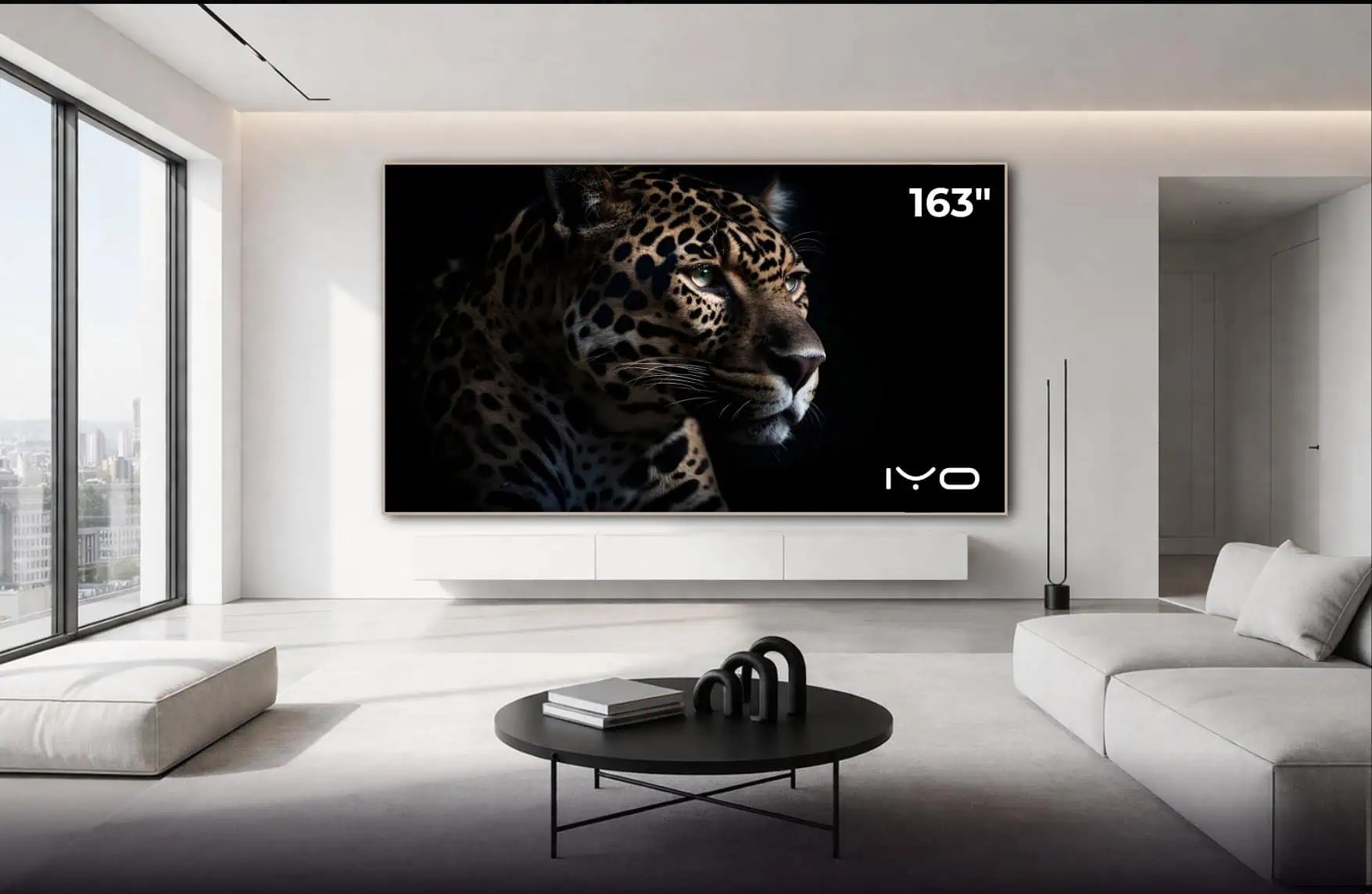
A 130-inch-class wall is one of the most common starting points for a luxury residential installation. Professionally installed, it typically lands around 20,000–35,000. A premium configuration with finer pixel pitch, higher-end processing, architectural integration, or more sophisticated control can reach 35,000–50,000+.
IYO’s SERA MicroLED system is designed for this size range. It is a structured residential platform with modular configurations for home theaters and multi-format viewing, including 16:9, 21:9, 1.90:1, 1.43:1, and 32:9. A 130-inch wall is not just a “130-inch TV.” You can build a traditional 16:9 display or something much wider and more cinematic.
This is where MicroLED becomes an architectural feature. A typical 150–165-inch residential installation falls around 30,000–60,000, and premium configurations can reach 50,000–80,000+.
At this size, cost is not set by the diagonal alone. A 16:9 wall, a 21:9 CinemaScope wall, a 32:9 ultra-wide wall, and a custom architectural opening all differ in physical area, module count, processing needs, and installation complexity. For projects that need custom dimensions and 4K through 8K+ resolution, our fully custom Alinor MicroLED walls are the better fit. For more on shapes and ratios, see our guide to size and aspect ratio.
Past 180 inches, you are no longer shopping for a television. You are building visual infrastructure. A reasonable residential planning range is 45,000–80,000. Premium custom configurations, especially with finer pitch and sophisticated architectural integration, run 70,000–120,000+.
At this level, installation becomes a meaningful part of the budget. The wall may require:
The display is only one part of the project.
Square-foot pricing is another useful lens. Current 2026 market references put premium installed direct-view LED in these ranges:
| Pixel pitch | Typical application | Approx. installed cost |
| P2.5–P3.0 | Larger rooms / commercial | 700–1,600 per sq. ft. |
| P1.8–P1.9 | Fine-pitch residential / commercial | 1,500–2,500 per sq. ft. |
| P1.2–P1.5 | Premium fine pitch | 2,000–3,500 per sq. ft. |
| P0.6–P0.9 | Ultra-fine premium MicroLED | 2,500–4,000+ per sq. ft. |
Broad market benchmarks, not a price list. Published 2026 pricing varies depending on whether the figure includes structure, processor, commissioning, electrical work, and installation.
There is a catch. Small residential walls do not follow simple square-foot math. A 25-square-foot wall still needs a processor, shipping, mounting, configuration, and someone to install and calibrate it. That is why a smaller luxury wall can carry a higher effective price per square foot than a large commercial installation.
The display is the headline, but it is not the whole bill. Here is what each part of the system typically adds.
Display hardware is usually the largest portion of the project. For premium indoor fine-pitch LED, hardware-only pricing sits well below the final installed price, particularly when the display is bought through manufacturing channels rather than as a turnkey U.S. installation. Some 2026 industry estimates place P0.9–P1.2 hardware at several hundred dollars per square foot, before U.S. processing, structure, shipping, engineering, and labor.
That is why hardware-only pricing misleads. A factory quote might say $20,000 for the LED panels, while the completed project becomes 30,000–40,000+ once the rest of the system is added. It is one of the biggest reasons two LED quotes look dramatically different.
For a straightforward residential wall, plan on approximately 5,000–15,000. Complex projects can reach 15,000–30,000+, especially with custom steelwork, architectural integration, difficult access, electrical upgrades, flush or recessed mounting, or unusual aspect ratios. Industry references commonly put installation and related integration at roughly 15–30% of project cost, and complex projects can exceed that.
Professional installation is not “put the panels on the wall.” It includes:
Precision matters. A wall can contain millions of individual pixels, and small alignment errors become very visible at scale. Our beginner’s installation guide explains the basic steps, and the CEDIA residential technology association is a useful resource for understanding what professional installation involves.
For many residential projects, the structure holding the wall costs approximately 2,000–8,000. A more complex architectural structure can go well beyond that. A simple wall-mounted bracket system is very different from:
SERA uses precision mounting solutions designed to simplify installation and keep cabinets aligned.
Many buyers do not think about the processor until someone explains it. It handles scaling, resolution, refresh rate, multiple sources, aspect-ratio management, multi-view layouts, signal switching, and HDR workflows. Budget approximately 2,000–8,000+, depending on the system.
Processing matters most when the goal is not “one giant TV.” If you want a large screen, side-by-side sources, sports, gaming, movies, 32:9, 21:9, and art mode in one room, the processor becomes a major part of the experience. SERA is built around multi-format and multi-source viewing rather than a fixed 16:9 television.
Depending on existing infrastructure, budget approximately 1,000–5,000+. This can include dedicated circuits, power distribution, electrical panel work, wiring, surge protection, cable management, and equipment-rack power. New construction makes this easier because electrical can be planned before the walls are finished. A retrofit can be considerably more complicated.
Professional calibration typically adds approximately 1,000–3,000. This is where the wall is tuned for brightness, color, gamma, white balance, uniformity, source configuration, HDR, and your viewing environment, using recognized video standards such as those developed by SMPTE. The goal is not just to make the wall turn on. It is to make it look right.
Large LED systems ship as specialized equipment and need careful packaging. Budget approximately 500–3,000+ for many residential projects. Bigger walls, international shipping, special crating, expedited delivery, or difficult access can raise it. It is another reason a factory-only quote should never be compared directly with a turnkey local installation quote.
If you want the wall to be part of the home rather than an isolated device, integration with Control4, Crestron, Savant, or another platform adds approximately 1,000–5,000+. It can cover power control, source selection, screen and aspect-ratio presets, lighting scenes, audio, Apple TV, gaming systems, media servers, and multi-view layouts.
For example, a single “Movie Mode” command can dim the lights, change the audio, switch the screen to CinemaScope, change the source, and set a brightness preset. That is where a display becomes part of the room.
Imagine a premium residential wall around 150–165 inches. A reasonable budget looks like this:
| Component | Typical budget |
| MicroLED display | 22,000–45,000 |
| Video processor | 2,000–6,000 |
| Mounting / structure | 2,000–6,000 |
| Installation | 5,000–12,000 |
| Electrical | 1,000–3,000 |
| Calibration / commissioning | 1,000–3,000 |
| Shipping / handling | 1,000–3,000 |
| Control integration | 1,000–5,000 |
| Typical total | 35,000–70,000+ |
Not every project needs every line item at the high end, and some manufacturers or integrators package several components together. That is why the right comparison is the complete system, not the LED cabinet price.
Because “MicroLED wall” describes the category, not the specification. Compare two hypothetical projects:
| Project A | Project B | |
| Size | 130-inch wall | 200-inch wall |
| Pixel pitch | 1.8 mm | 0.9 mm |
| Format | Standard 16:9 | Custom 21:9 CinemaScope |
| Structure | Straightforward wall mounting | Custom, architectural integration |
| Processing | Basic processor | 4K+ processing |
| Extras | Existing electrical infrastructure | Smart-home integration, professional calibration |
| Potential budget | 20,000–30,000 | 70,000–120,000+ |
Both are MicroLED. They are completely different systems.
Want a number for your room? Send us your wall dimensions and seating distance, and we will help you scope it. Request a custom MicroLED quote.
Pixel pitch is the distance between LEDs, measured in millimeters. A smaller pitch means more pixels in every square foot, which generally means more LEDs, more precision, more processing, and higher cost. A 0.9 mm wall contains dramatically more pixels per square foot than a 1.8 mm wall.
If you target roughly native 4K (3840 × 2160 pixels), pitch has a major effect on physical wall size:
| Pixel pitch | Approx. 4K width | Approx. 4K height | Approx. diagonal |
| 0.6 mm | 90.7″ | 51.0″ | 104″ |
| 0.7 mm | 105.8″ | 59.5″ | 121″ |
| 0.9 mm | 136.1″ | 76.5″ | 156″ |
Reference calculations (pixel count × pitch). Real installations can use other resolutions and aspect ratios.
The smaller the pitch, the smaller the physical wall can be at the same pixel count. That is why a 0.6 mm 4K wall is physically smaller than a 0.9 mm 4K wall. Alinor offers 0.6, 0.7, and 0.9 mm options for custom 4K, 6K, and 8K walls. Our pixel pitch and resolution guide covers the details.
No. You do not necessarily need the smallest pitch available. Viewing distance matters. A homeowner sitting 18 feet away does not need the same pitch as someone sitting four feet from the display. If your audience sits farther back, a larger pitch can look excellent without paying for pixel density nobody can resolve from the seats.
The right question is not “What is the smallest pixel pitch?” It is “What pitch makes sense for my viewing distance and the experience I want?” Answering that well can save thousands of dollars.
IYO LED designs and engineers these as different visual infrastructure platforms, not one generic LED product. All use LED modules rated up to 100,000 hours.
| System | Best for | Typical budget |
| SERA | Structured residential MicroLED, multi-format home theaters | 20,000–60,000+ |
| Alinor | Fully custom walls, 4K / 6K / 8K+, architectural integration | 50,000–150,000+ |
| Eredim | Permanent outdoor installations, 115″ and 159″ configurations | 25,000–70,000+ |
Budgets depend on configuration, size, pitch, installation, and integration.
SERA is for homeowners who want a premium display without starting from a blank sheet of paper. It offers structured configurations, multi-format capability, COB technology, HDR processing, and modular installation. It is often the most logical starting point for a residential project that needs serious MicroLED performance with a more predictable system. To learn why COB matters, read what COB technology is.
Alinor is for projects where the standard answer is not good enough: custom dimensions, custom aspect ratios, 4K, 6K, 8K+, ultra-fine pixel pitch, and architectural integration. It is designed so the display becomes part of the architecture rather than something installed onto it. At the highest end, the display can become a six-figure architectural component, much closer to a custom visual environment than a television.
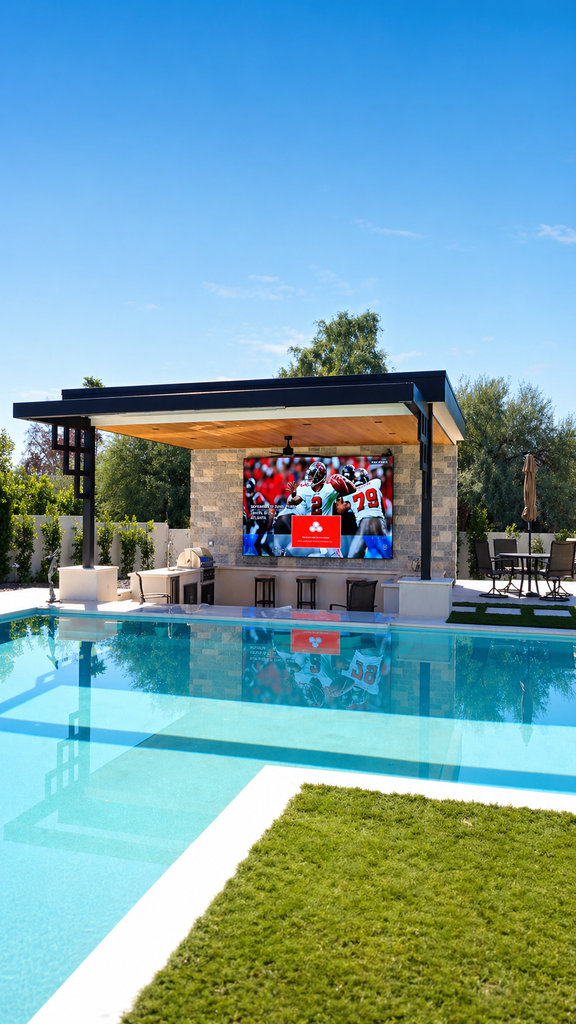
Outdoor installations add cost because the display must handle sunlight, rain, dust, temperature, moisture, electrical protection, and outdoor structure. Eredim is built for permanent outdoor installations, including patios, pool areas, outdoor theaters, hospitality, and architectural applications, with 115-inch and 159-inch configurations. Outdoor MicroLED is not indoor MicroLED with a raincoat. The environment changes the engineering.
Upfront, no. A $2,000 television is still a much cheaper way to watch Netflix, and a projector and screen can deliver an enormous image for far less money. So why buy MicroLED? Because you are not buying only inches. You are buying scale, brightness, contrast, seamless modularity, custom dimensions, multiple aspect ratios, multi-view capability, architectural integration, and long-term infrastructure. MicroLED also performs exceptionally well in bright rooms where projection struggles.
For a full technology comparison, read our guide to MicroLED vs OLED vs projector.
If your only goal is the biggest picture for the least money, buy a projector. If you want a permanent, ultra-large system that works in daylight, supports multiple formats, and becomes part of the architecture, MicroLED gets much more interesting. It is not an apples-to-apples comparison. A projector is an imaging device. A custom MicroLED wall can become part of the room itself.
IYO LED systems use modules rated for up to approximately 100,000 hours, though actual life depends on usage, brightness, environment, and operating conditions. At six hours a day, 100,000 hours is more than 45 years. That does not mean every component lasts 45 years, since processors and power supplies have different service lives. The useful way to think about it: a well-designed wall is permanent visual infrastructure, not a disposable television.
Before requesting a quote, answer these eight questions:
For a quick starting point, use this:
| Tier | Budget | What it typically means |
| Entry-level premium residential | 20,000–30,000 | About 120–140″, standard configuration, moderate pitch, straightforward installation |
| Serious luxury residential | 30,000–60,000 | About 140–165″, finer pitch, better processing, professional installation and integration |
| Large-format premium | 50,000–90,000+ | About 165–205″+, higher-end processing, architectural requirements |
| Ultra-premium custom | 75,000–150,000+ | Very fine pitch, 4K–8K+, custom dimensions, unusual aspect ratios, advanced processing |
Budgeting ranges, not fixed retail prices. The final number depends on the actual specification and site.
You can buy LED hardware cheaply. That does not mean you are getting a cheap project. A low quote may leave out structure, electrical work, the processor, calibration, installation, shipping, integration, or warranty. Then the “cheap” project starts collecting change orders, and by the time the wall works, the gap may be small. A quote that says “LED wall: $25,000” is not necessarily cheaper than “Complete MicroLED system: $32,000.” The second one may simply include everything.
Use this checklist to compare quotes line by line:
If you do not know what is included, you do not know the price.
For residential projects, a realistic planning range is approximately 20,000–60,000 for many 120–165-inch systems. Larger and highly customized installations can reach 75,000–150,000+. The biggest factors are screen size, pixel pitch, resolution, structure, processing, installation, and integration.
A straightforward residential installation may cost approximately 5,000–15,000. Complex architectural installations can reach 20,000–30,000+. Industry sources commonly report installation and related integration adding roughly 15–30% to the overall project, though complex installations can exceed that.
Yes, significantly. A smaller pixel pitch means more pixels per square foot and generally higher manufacturing cost. But choose pitch based on your actual viewing distance, not the smallest number available.
Yes, upfront, and usually by a significant amount. An OLED TV is a mass-produced consumer product, and a projector is one of the most economical ways to get a very large image. MicroLED’s advantage is the combination of scale, brightness, contrast, modularity, custom aspect ratios, and permanent installation.
Not necessarily. 4K is an excellent target for many residential walls, but the right resolution depends on physical size, viewing distance, content, and desired image density. Large custom walls can justify 6K or 8K.
Yes. Because LED walls are modular, they can be designed around different aspect ratios instead of being locked into a traditional TV shape. The SERA platform, for example, supports 16:9, 21:9, 1.90:1, 1.43:1, and 32:9.
The answer is no longer “contact us for pricing.” If you are planning a residential MicroLED project in 2026, start here:
| Project type | Planning budget |
| Smaller premium residential wall (130–140″) | 20,000–50,000 |
| Serious luxury installation (140–165″) | 30,000–60,000, up to $80,000 premium |
| Large-format installation (165–205″) | 50,000–90,000+ |
| Ultra-premium, highly customized environment | 75,000–150,000+ |
The goal is not to find the cheapest number. It is to find out what the number includes. Start with your wall dimensions, your viewing distance, and the experience you want. From there, the right pitch, resolution, aspect ratio, and installation approach become much easier to choose.
At IYO LED, we design and engineer MicroLED systems in California, from structured SERA walls to fully custom Alinor installations. The world was never 16:9, and your wall does not have to be either. Contact IYO LED for a custom MicroLED quote and we will help you build the right wall.