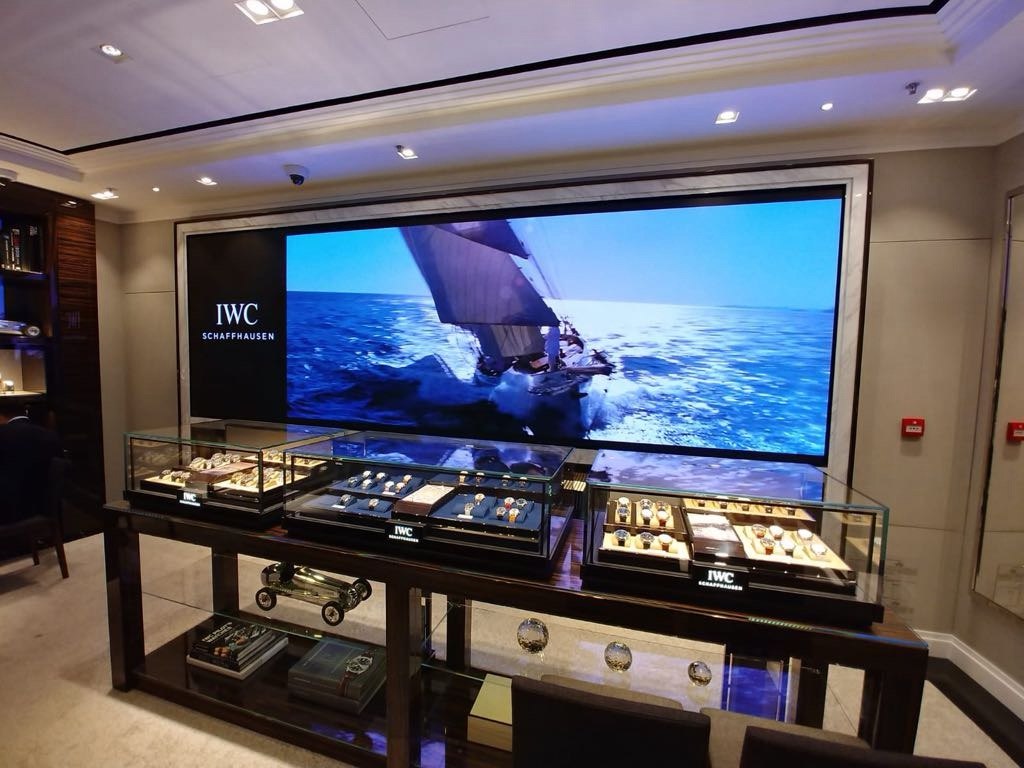
You are planning a big-screen room, and a 100-inch TV looks like the obvious answer. It is affordable, it ships to your door, and it fits a standard living room. Then you stand in front of one and wonder if it is really big enough.
That question is exactly where MicroLED vs 100 inch TV becomes a real decision. A 100-inch TV is a great product at roughly 1,700–4,500. A MicroLED wall costs several times more, but it changes what a screen can be: larger, any shape, and built into the room. This guide compares price, size, viewing distance, and fit, so you can tell which one is right for your home. The numbers are real, and so are the trade-offs.
Quick Answer
A 100-inch TV costs roughly 1,700–4,500 and suits seating about 10–14 feet away. A MicroLED wall costs roughly 15,000–60,000 for 100–165 inches, with up to 2.7 times the screen area, custom aspect ratios, and a permanent build. Choose a TV for value. Choose MicroLED when size, shape, or architecture matter.
At the same size, a 100-inch TV wins on price by a wide margin. Mainstream 100-inch TVs from major brands list at about $1,700 to $4,500 in October 2026, based on a retail price tracker (outdoor and specialty models excluded). Premium MicroLED walls start where TV prices end.
| Option | Screen size | Typical budget |
| 100-inch TV (mainstream) | 100″ | 1,700–4,500 |
| MicroLED wall, entry | 100–120″ | 15,000–25,000 |
| MicroLED wall, mid-size | 130–140″ | 20,000–35,000 |
| MicroLED wall, large | 150–165″ | 30,000–60,000 |
TV prices come from retail listings and change often. MicroLED figures are planning ranges for a professionally designed and installed premium residential system, not fixed retail prices.
A TV is a finished product. The screen, processor, and smart platform arrive in one box, so the sticker price is close to the real cost. You still budget for a wall mount or stand, a soundbar or speakers, and delivery help, because a 100-inch set is large and awkward to move.
A MicroLED wall is a system. The price covers the display modules, a video processor, a mounting structure, electrical work, installation, calibration, and shipping. Control integration with Control4, Crestron, or Savant is often added. Our full guide to MicroLED video wall cost breaks down each line item, so you can compare quotes fairly.
Diagonal inches understate the jump. Screen area grows with the square of the size, so a modest step up in diagonal is a big step up in picture. Here is the math for a standard 16:9 shape:
| Diagonal | Width × height | Screen area | vs 100-inch TV |
| 100″ | 87.2″ × 49.0″ | 29.7 sq. ft. | 1.0× |
| 130″ | 113.3″ × 63.7″ | 50.1 sq. ft. | 1.7× |
| 150″ | 130.7″ × 73.5″ | 66.8 sq. ft. | 2.3× |
| 165″ | 143.8″ × 80.9″ | 80.8 sq. ft. | 2.7× |
Calculated geometry for 16:9 screens. MicroLED walls can also be built in other shapes.
A 130-inch wall gives you 70% more picture than a 100-inch TV. A 165-inch wall nearly triples it. That is the difference between a big TV and a cinema.
A common home-theater guideline is for the screen to fill about 30 to 40 degrees of your field of view. Industry bodies such as SMPTE publish viewing-angle guidance along these lines. Applying that rule gives these seating distances:
| Screen | Closest (40° view) | Farthest (30° view) |
| 100″ TV | 10.0 ft | 13.6 ft |
| 130″ wall | 13.0 ft | 17.6 ft |
| 165″ wall | 16.5 ft | 22.4 ft |
This matters in practice. If your sofa sits 16 feet from the wall, a 100-inch TV fills well under 30 degrees of your view. It looks smaller than you expected. A larger wall fits the room you actually have.
A 100-inch TV is excellent value. It starts to fall short when your room, your content, or your architecture asks for more.
Beyond roughly 100 inches, mainstream TV choices thin out fast, and every size is one fixed shape. A modular MicroLED wall is built from modules to fit your space, so you can choose the exact width and height.
A TV is a 16:9 rectangle. Cinema content is often wider, so widescreen films show black bars above and below. The world was never 16:9. A MicroLED wall can be designed around the formats you watch, and SERA supports 16:9, 21:9, 1.90:1, 1.43:1, and 32:9. Learn more in our guide to 16:9 vs 2.35:1 and our post on size and aspect ratio.
A TV sits on or in front of a wall. A MicroLED wall can fill an architectural opening edge to edge, with no gaps and no bezel. For a wall that must match an exact niche, our custom Alinor MicroLED walls offer 4K, 6K, and 8K options at 0.6, 0.7, and 0.9 mm pixel pitch.
IYO LED modules are rated for up to 100,000 hours. At six hours a day, that is more than 45 years. The rating does not cover every component, but it shows the wall is designed as permanent visual infrastructure, not a disposable screen.
A TV is the smarter buy in several situations. Be honest about these:
If that list describes you, buy the TV and enjoy it. Our comparison of MicroLED vs OLED vs projector can help you pick the right type of screen.
MicroLED earns its price when one or more of these is true:
IYO LED designs and engineers its systems in California. Here is how they stack up against a big TV:
| 100″ TV | SERA | Alinor | |
| Best for | Value, easy setup | Structured residential MicroLED | Fully custom walls |
| Shape | Fixed 16:9 | Five formats, from 16:9 to 32:9 | Any custom size |
| Technology | Consumer 4K TV | COB MicroLED, HDR processing | COB MicroLED, 4K / 6K / 8K UHD |
| Typical budget | 1,700–4,500 | 20,000–60,000+ | 50,000–150,000+ |
SERA and Alinor budgets depend on configuration, size, pitch, installation, and integration.
SERA is the most balanced, more accessible way into MicroLED, and the usual first step for a home theater. Alinor is for projects where a standard size will not do. Browse our residential MicroLED displays to see both in real rooms.
Work through these steps before you spend anything:
New to LED walls? Start with our complete guide to LED walls.
It depends on your room and goals. A 100-inch TV is far cheaper and works well at 10–14 feet. A MicroLED wall is worth it when you want a larger or custom-shaped screen, need daylight brightness, or are building the display into the architecture.
Mainstream 100-inch TVs from major brands cost roughly $1,700 to $4,500 in October 2026. Prices change often, and specialty or outdoor models cost more.
A professionally installed premium residential MicroLED wall typically costs about 15,000–25,000 at 100–120 inches, 20,000–35,000 at 130–140 inches, and 30,000–60,000 at 150–165 inches. That includes more than the display.
A 130-inch wall is a common step up. It has about 70% more screen area than a 100-inch TV and suits seating around 13–17 feet away.
Yes. Because LED walls are modular, they can be designed in ratios such as 21:9 or 32:9. SERA supports 16:9, 21:9, 1.90:1, 1.43:1, and 32:9.
In the MicroLED vs 100 inch TV decision, the TV is the best value in big-screen viewing, and for many rooms it is enough. When you want more scale, a custom shape, or a display that belongs to the architecture, a MicroLED wall is the better investment. Match the screen to your seating distance, your content, and your room, and the choice becomes clear.
Ready to see what fits your space? Compare SERA and Alinor, then contact IYO LED for a custom MicroLED quote. Send your wall dimensions and seating distance, and we will help you size it.